News
Wheel loaders are among the most versatile machines on a job site. From stockpiling aggregates and loading trucks to cleanup, snow removal, and material handling, these machines deliver power, speed, and agility. But when someone asks, “How many types of wheel loaders are there?” the answer isn’t just a single number. The different types are best understood by considering several factors: size class, steering architecture, linkage style, lift configuration, and powertrain.
The size class affects bucket capacity, breakout force, transportability, and total cost of ownership (TCO).
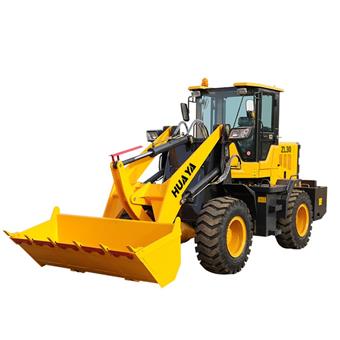
Operating weight: ~4,000–8,000 kg (8,800–17,600 lb)
Bucket capacity: ~0.5–1.2 m³
Best for: Confined worksites, landscaping, municipal projects, agriculture, snow removal.
Why choose: Low fuel consumption, suitable for road use, easy to transport, excellent visibility.
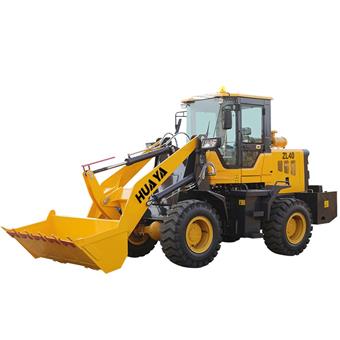
Operating weight: ~8,000–13,000 kg
Bucket capacity: ~1.2–2.0 m³
Best for: small quarries, concrete plants, material yards, and batch operations.
Why choose: A step up in power and durability without the size of a medium-sized machine.
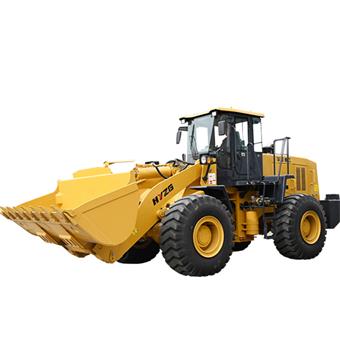
Operating weight: ~13,000–25,000 kg
Bucket capacity: ~2.0–4.0 m³
Best for: high-utilization production scheduling, waste/recycling, infrastructure.
Why choose: the “sweet spot” for performance, availability, and resale value.
Operating weight: ~25,000–50,000+ kg
Bucket capacity: ~4.0–10+ m³
Best for: heavy production, load-and-carry operations, hot slag, port operations.
Why choose: maximum breakout force, long lift arms, heavy-duty axles, and frames.
Operating weight: 50,000–200,000+ kg
Bucket capacity: 10–35+ m³
Best for: loading rigid-frame haul trucks in mines and mega-quarries.
Why choose: Extreme productivity, long service life, and dedicated mine support packages.
A quick rule of thumb: Match bucket capacity to truck/trailer volume in terms of the number of full passes (e.g., 3–5 passes) to reduce cycle times and fuel consumption per metric ton.
The way the machine steers affects the turning radius, tire wear, and stability.
Articulated Steering (Most Common)
The machine hinges at the center.
Pros: tight turning, excellent maneuverability, comfortable to load and carry.
Cons: The center joint requires periodic inspection; turning while under load can increase tire wear.
All-Wheel-Steer (AWS) / Four-Wheel-Steer
The front and rear axles steer to reduce the turning radius without articulation.
Pros: precise placement, stability with less rear swing, great for narrow aisles.
Cons: more complex steering systems; typically found on compact or specialty models.
The linkage determines digging behavior, visibility, and parallel-lift capability.
Z-Bar Linkage (Standard Digging Loader)
Pros: strong breakout force for driving piles; simple and robust.
Ideal for: Aggregate yards, general construction, quarry face work.
Parallel-Lift / Toolcarrier (TC) Linkage
Pros: Keeps the forks and attachments level throughout the lifting motion; excellent for pallet handling.
Ideal for: material yards, industrial sites, and waste/recycling operations using a variety of attachments.
High-Lift and Extended-Reach Variants
Pros: more dump clearance to reach over high-sided trucks/hoppers.
Ideal for: feed mills, ports, waste transfer stations, bulk handling.
Standard Lift: balanced reach and breakout for general loading.
High Lift: Longer arms for increased dump height and rollback; slightly reduces breakout.
Telescopic Wheel Loaders: The boom extends for extra reach and stacking height.
Pros: Telescopic reach with loader stability; great for agriculture, pallets, and stacking.
Cons: more moving parts; typically lower breakout compared to rigid-arm loaders.
Diesel (Tier 3–Final/Tier 4f–Stage V)
Still the leading choice for heavy-duty motorcycles; the most extensive dealer support and fueling infrastructure.
Diesel-Electric & Hybrid Assist
Electric drives and hybrid systems recover energy and improve efficiency during stop-and-go driving.
Battery-Electric (BEV) Wheel Loaders
Rapidly emerging in compact and small classes; ideal for indoor, urban, or noise-sensitive locations.
Benefits: zero tailpipe emissions, low vibration and noise, and reduced maintenance (no engine oil or exhaust aftertreatment).
Factors to Consider: duty cycle, charging logistics, ambient temperature, battery capacity.
Waste & Recycling Packages: heavy-duty guards, reversible fans, high-capacity coolers, automatic lubrication.
Forestry & Timber: log grapples, protective screens, heavy-duty tires, and high-lift capabilities.
Snow & Municipal: quick couplers, pusher boxes, high-flow hydraulics, and cab heaters.
Quarry & Aggregate: quarry-duty axles, rock buckets, tire protection chains.
Agriculture: lightweight material buckets, bale spears, and tele-wheel loaders for stacking.
With the right attachment, a wheel loader becomes a whole new machine:
General-purpose, rock, and light-material buckets
Forks and pallet forks (parallel-lift forks are featured here)
Grapples (log, scrap, utility)
High-dump buckets for low-density materials
Pushers/snow blades, angle brooms, mulchers
Quick couplers (hydraulic or mechanical) for rapid changes
Define the primary task: truck loading, stockpile management, pallet handling, or site cleanup.
Align production volumes with production targets: Target 3–5 pass loads for trucks to minimize cycle time.
Check material density: Whether the material is light or heavy determines the bucket style and capacity.
Confirm site constraints: aisle width, turning radius, height clearances, and bridge limits.
Select linkage & lift: Z-bar for digging, tool carrier for forks, high-lift for clearance.
Select powertrain: Diesel for heavy-duty production; BEVs/hybrids for noise- and emissions-sensitive sites.
Specify options: security, automatic lubrication, ride control, payload scales, camera/radar safety aids.
Run the numbers: Compare fuel/energy consumption per metric ton, maintenance intervals, tire life, and operator comfort (fatigue = productivity).
There isn’t a single fixed number. Wheel loaders are categorized by size (5+ classes), steering (2), linkage (2+), lift (3), and powertrain (3+). These combinations result in dozens of practical “types.”
Compact wheel loaders feature articulated/AWS steering, offering better fuel efficiency, higher travel speeds, and improved visibility. Skid-steer loaders pivot on their wheels (resulting in high tire wear) and excel in extremely tight spaces.
Choose the Z-bar for digging and breakout force when working with dense piles. Choose the tool carrier or parallel-lift for forks, pallet handling, and applications requiring a level lift.
Use a high-lift system when your standard dump height is insufficient to clear truck bodies or hoppers—a common issue in feed mills, recycling plants, and ports.
Yes—especially in compact or small vehicles designed for indoor or urban use. Evaluate the duty cycle, charging requirements, and ambient temperatures to select the correct battery size.
Match the tread and compound to the surface: L-2 (traction), L-3 (rock), L-4/L-5 (heavy rock/abrasion), snow compounds, and consider using tire chains in quarries.
Ride control, joystick steering, payload weighing, automatic lubrication, rear and 360° cameras, effective HVAC, and low in-cab noise. Comfort reduces fatigue and errors.