News
When you think of a wheel loader, what often comes to mind is a powerful machine effortlessly lifting and moving heavy materials. But have you ever wondered what exactly makes this machine so versatile? The answer lies in its wide range of attachments. Just as a Swiss Army knife can perform multiple tasks with its various tools, a wheel loader can adapt to countless job requirements simply by swapping out its attachments. From construction sites to farms, from snow-covered streets to mining operations, it is these attachments that transform a single-purpose machine into a versatile “all-around workhorse.”
Wheel loader attachments are specialized tools designed to be mounted on the front of a loader. They break the machine’s limitation to performing a single task, enabling it to handle a wide variety of operations—including digging, lifting, sweeping, snow removal, and even grinding. Think of these attachments as the loader’s “hands” that can be swapped out at any time; each “hand” is carefully engineered to perform a specific task more effectively and efficiently.
Attachments are much more than simple accessories; they are powerful tools for boosting productivity. Not only do they greatly expand the versatility of machinery, but they also reduce the need for multiple specialized machines on construction sites, thereby effectively saving money, space, and fuel.
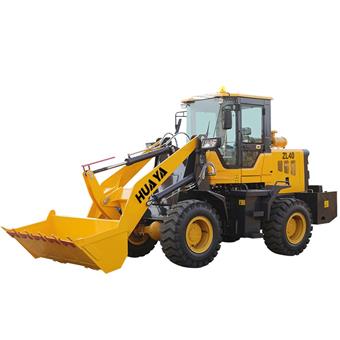
The bucket is the most iconic attachment on a wheel loader, and it truly deserves this distinction.
General-Purpose Bucket — Ideal for loading and unloading soil, sand, gravel, or bulk materials, and the top choice for standard configurations.
Rock Bucket — Manufactured from heavy-duty steel and equipped with reinforced bucket teeth, it is specifically designed to handle rock and rugged terrain.
Multifunctional 4-in-1 Bucket — This versatile bucket combines loading, bulldozing, gripping, and grading functions into one, making it the ideal choice for operators seeking operational flexibility.
High-Dump Bucket — Designed for loading operations onto high-sided trucks or containers, it provides additional unloading height.
Light-Duty Bucket — With a larger capacity but lightweight construction, it is ideal for loading and unloading snow, mulch, or other lightweight, bulky materials.
Fork attachments can turn your wheel loader into a workhorse for material handling.
Pallet forks — an essential tool for moving palletized goods in warehouses or on construction sites.
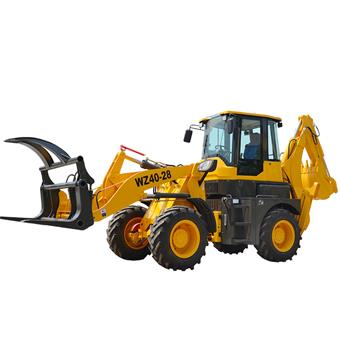
Log Forks — Designed specifically for the safe transport of logs during forestry operations.
Hay Fork — A valuable tool in agricultural production, used for handling hay bales or silage.
A grab bucket is like a loader’s giant “claw,” giving the machine the ability to pick up irregularly shaped materials.
Tree Root Grapple — Ideal for land clearing, as well as removing stumps and tree roots.
Scrap Grab — The ideal tool for recycling centers and demolition operations, specifically designed to handle all types of irregularly shaped waste.
Demolition Grapple — Features a more robust and durable design, specifically engineered for handling heavy and sharp-edged materials.
When winter sets in or the land needs to be leveled, various types of blades and plowshares come in handy.
Bulldozer Blade — Transforms a loader into a small bulldozer for moving soil.
Snow Plow — Used to clear snow from roads, parking lots, and driveways.
V-shaped shovel — Ideal for cutting through deep snow or pushing heavy debris.
These attachments performed exceptionally well during the final cleanup and site clearance.
Landscape rake — used to collect debris and level the soil.
Power Sweepers — Keep streets, parking lots, and work sites spotless.
Root Rake — Aids in forestry operations and land clearing by raking away tree roots and branches.
Not all materials are in a neat, easy-to-scoop form—and that’s when these tools really come in handy.
Hay Bale Fork — Used to pierce and move large hay bales.
Pipe/Log Handler — Designed to safely handle cylindrical objects such as pipes or logs.
Clamping and Gripping Tools — Designed to securely hold irregularly shaped objects such as tires or barrels.
They come in very handy when standard attachments fall short.
Auger Drive Unit — Used to drill holes required for pilings or foundations.
Snow Blower — Throws snow a long distance away, rather than simply pushing it aside.
Hydraulic Breaker — Breaks concrete and rock with power comparable to a “supercharged” handheld breaker.
Stump Grinder — Grinds stubborn stumps into wood chips.
Choosing the right attachment isn't just about picking the one that looks the coolest. You need to consider the following factors as a whole:
Equipment Compatibility — Not all attachments are compatible with every loader model.
Assignment Requirements — Please select the tool that best suits your specific task.
Hydraulic Flow and Power — Some attachments require additional hydraulic power.
Durability and Manufacturing Quality — Heavy-duty operations place extremely high demands on the sturdiness of attachments.
Maintenance and Safety — Easy maintenance is key to ensuring the long-term, reliable operation of equipment.
The value of implements lies in their practical benefits:
One machine, multiple uses—no need to purchase additional equipment.
Save on fuel, storage space, and operator training costs.
By quickly adapting to different work tasks, production efficiency is significantly improved.
Use specialized tools rather than makeshift solutions to effectively improve workplace safety.
Proper maintenance is essential for extending the service life of attachments.
Clean immediately after use—to prevent rust and the buildup of dirt.
Lubricate moving parts—to ensure they operate smoothly and function properly.
Regular Inspections—Check for cracks, bent teeth, hydraulic leaks, and other issues.
Inspect the hydraulic system—hydraulically driven attachments require continuous monitoring.
Proper Storage—When not in use, keep it dry and store it off the ground.
Construction and Demolition—Buckets, grapples, and hydraulic breakers can easily handle all types of rubble and debris.
Agriculture and Livestock—Hay fork, hay spike, and hay rake help farms maintain high yields and efficiency.
Mining and Quarrying—Heavy-duty buckets and rock-cutting tools handle several metric tons of material every day with ease.
Municipal Services and Snow Removal—Snow plows and snow blowers ensure that roads remain clear and safe.
Landscaping and Forestry—Hay Rakes, Grab Buckets, and Stump Grinders Help You Maintain and Manage Your Land Efficiently.
Wheel loader attachments are the “secret weapon” that gives these machines their remarkable versatility. Simply by swapping out an attachment, a wheel loader is no longer limited to mere earthmoving—it can instantly transform into a forklift, snow blower, sweeper, or even a powerful tool for demolition work. For businesses of all kinds, this translates to higher work efficiency, lower operating costs, and greater productivity. Whether you’re on a construction site, a farm, or a municipal worksite, choosing the right attachment can upgrade your wheel loader into a versatile and efficient “multi-tasking powerhouse.”
The general-purpose bucket is the most commonly used attachment because it can handle a variety of tasks, including digging, shoveling, and loading.
This is not usually the case. Although some accessories may look similar, they are designed specifically for different machines and may therefore not be compatible. Be sure to check with the manufacturer.
Please review the loader's specifications, including lifting capacity and hydraulic requirements, and ensure they match the attachment's requirements.
No, attachments are not always universal. Their compatibility depends on the machine's size, the type of connector, and the hydraulic system.
Yes, attachments that require greater hydraulic power or add extra weight may indeed lead to increased fuel consumption, but they also boost productivity, thereby achieving an overall balance in efficiency.
Previous. Where can I buy a wheel loader?