News
When it comes to heavy-duty equipment for construction sites, farms, and other rugged terrains, rough-terrain forklifts and telehandlers are the top contenders. But how do you decide which one is right for your needs? Are these machines interchangeable, or are they worlds apart?

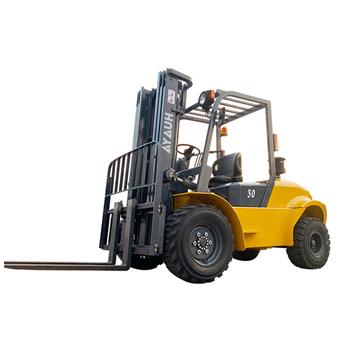
A rough-terrain forklift is a heavy-duty forklift designed to operate on uneven, challenging surfaces such as dirt, gravel, or mud. Unlike standard warehouse forklifts, it features rugged tires, a sturdy construction, and high ground clearance.
Powerful Engine: These machines are typically powered by diesel, which gives them the power to lift heavy loads.
Tough Tires: Equipped with pneumatic tires for better traction on rough terrain.
High Stability: Their wide base ensures they remain stable even on sloped or uneven surfaces.
Construction Sites
Agriculture
Lumber yards
Outdoor Material Handling
A telehandler, or telescopic handler, is a versatile machine often described as a hybrid between a crane and a forklift. It features an extendable boom that allows it to reach heights and distances that traditional forklifts cannot.
Telescopic Boom: This arm can extend both vertically and horizontally, providing exceptional reach.
Attachment Options: Compatible with buckets, platforms, and other tools for versatile use.
Enhanced Maneuverability: Can navigate tight spaces with precision.
Moving heavy loads to elevated locations
Roofing and Siding Projects
Handling materials in confined spaces or at great heights
These are compact, sturdy, and built to carry heavy loads over short distances. Their design prioritizes stability and durability over range.
Telehandlers, on the other hand, are designed for flexibility and reach. Their long, extendable arm is their defining feature, making them suitable for a wide range of applications.
Ideal for lifting and transporting heavy loads horizontally.
Limited reach compared to telehandlers.
Superior vertical and horizontal reach.
Can effortlessly access hard-to-reach areas.
While rough-terrain forklifts are designed to move heavy loads on uneven surfaces, telehandlers take versatility to the next level with their attachment options.
The rugged design of rough-terrain forklifts ensures they can withstand the harshest outdoor conditions.
Their simple operation makes them the go-to choice for tasks that require consistent load movement.
If you’re looking for a rough-terrain forklift for sale, you’ll find that these machines offer excellent value for money, especially for construction or agricultural use.
Thanks to their telescopic booms, telehandlers excel at tasks that require access to elevated or distant areas.
From construction to agriculture, telehandlers excel in a wide range of industries thanks to their ability to switch between attachments.
Despite their versatility, telehandlers are compact enough to maneuver in tight spaces.
If you’re primarily working on rough and uneven ground, a rough-terrain forklift is your best option. For projects requiring extended reach or height, choose a telehandler.
Determine the weight and size of the loads you need to move. Rough-terrain forklifts handle heavier loads at ground level, while telehandlers are better suited for tasks at elevated heights.
If you need a machine that can do it all—from lifting materials to acting as a crane—a telehandler is the way to go.
Built to last, these forklifts require minimal maintenance when used properly. Regular tire checks and engine servicing will keep them in top condition.
Because of their complexity, they require more frequent maintenance, especially if you’re using multiple attachments.
The decision between a rough-terrain forklift and a telehandler depends on your specific needs. If you need a machine to handle heavy loads on rugged surfaces, a rough-terrain forklift is the obvious choice. But if reach, versatility, and precision are crucial, telehandlers offer unmatched advantages.
Both machines are valuable assets in their respective fields. Evaluate your project requirements, budget, and long-term goals to make the right choice.
Not entirely. Telehandlers are more versatile, but they may not be as efficient at handling loads as rough-terrain forklifts on uneven surfaces.
The construction, agriculture, and lumber industries rely heavily on these machines for their rugged capabilities.
They can be, but purchasing a rough-terrain forklift offers great value for long-term use.
Telehandlers are equipped with buckets, pallet forks, lifting hooks, and work platforms, among other attachments.
Rough-terrain forklifts are easier to operate, while telehandlers require more training because of their versatility.
Previous. Which industry uses the most forklifts?