News
Rough-terrain forklifts These are specialized machines designed to operate on uneven, rocky, and challenging surfaces. Their robust construction and advanced features make them indispensable in industries such as construction, agriculture, and logistics. When choosing a rough-terrain forklift, understanding its design is crucial for ensuring optimal performance and efficiency. The two basic types of rough-terrain forklifts are vertical-mast forklifts and telescopic handlers, each offering unique advantages for specific applications.

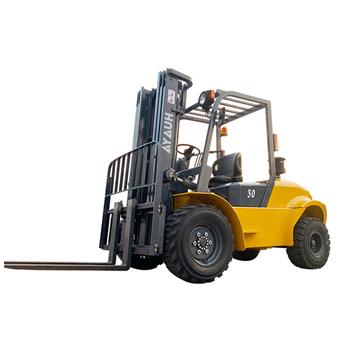
Vertical-mast rough-terrain forklifts resemble traditional forklifts but are engineered to handle outdoor challenges. These forklifts feature a simple design that combines reliability with functionality.
Design and Build: Vertical mast forklifts feature a compact frame, making them ideal for tight outdoor spaces. Their rugged tires and enhanced suspension systems allow for smooth movement across uneven terrain.
Lift Capacity: These forklifts typically have high lifting capacities, making them suitable for heavy-duty tasks such as moving construction materials or loading pallets in outdoor environments.
Maneuverability: With a simple mast system, they offer excellent maneuverability, making them ideal for tasks that require precision.
Vertical-mast forklifts are ideal for applications where the ground is stable, such as:
Construction Sites: Transporting heavy building materials such as bricks and cement.
Agriculture: Moving bales of hay or farming equipment.
Warehousing: Handling outdoor inventory when a stable platform is available.
Telescopic handlers, often referred to as telehandlers, combine the lifting power of forklifts with the versatility of cranes. These machines feature an extendable boom, allowing them to reach greater heights and distances.
Boom System: Unlike the fixed mast of vertical forklifts, telehandlers have an extendable boom that can rotate and tilt, offering unmatched versatility.
Terrain Adaptability: Equipped with all-terrain tires and powerful engines, telehandlers navigate effortlessly through mud, gravel, and steep inclines.
Load Capacity and Range: These forklifts offer greater reach and capacity, making them suitable for lifting loads to elevated positions or over obstacles.
Telehandlers are best suited for tasks that require reach and flexibility, such as:
Construction: Reaching upper floors to deliver materials.
Farming: Loading feed or hay into storage silos.
Event Setup: Helping to assemble large outdoor structures such as stages or tents.
When choosing between vertical mast forklifts and telehandlers, consider the following factors:
Application Requirements: For simple tasks on stable ground, vertical mast forklifts are the ideal choice. For jobs requiring height and flexibility, telehandlers are better suited.
Budget: Vertical mast forklifts are generally more cost-effective, while telehandlers offer advanced features at a higher price point.
Environment: Telehandlers excel in rough and challenging terrain, whereas vertical-mast forklifts perform well in moderately uneven areas.
Both styles offer numerous benefits tailored to specific tasks.
Enhanced Stability: Rough-terrain forklifts are designed with a low center of gravity and advanced stabilization features.
Durability: Their rugged construction ensures durability in demanding environments.
Productivity: Equipped with powerful engines, they complete tasks more quickly, saving time and effort.
Understanding the two basic types of rough-terrain forklifts—vertical-mast forklifts and telescopic handlers—is essential for making an informed decision. Each type offers unique advantages tailored to specific industries and applications. By carefully assessing your operational needs and terrain challenges, you can choose the forklift type that maximizes efficiency and performance.