News
When it comes to lifting and moving heavy loads, forklifts are undoubtedly the equipment of choice in warehouses, construction sites, and industrial facilities. However, not all forklifts perform equally well; gaining a thorough understanding of the differences between standard forklifts and all-terrain forklifts will help you save time and money and avoid unnecessary headaches.

The classic forklift is often referred to as the “reliable sedan” of the material handling industry. It is specifically designed for efficient operation on flat, stable surfaces, such as warehouse floors, factory floors, or paved yards. Here are its key features:
Standard forklifts feature a compact design and agile handling, making them ideal for maneuvering in tight spaces. Due to their relatively low ground clearance, these machines perform particularly well indoors or in controlled environments, such as on level ground.
Standard forklifts are typically equipped with solid rubber tires or cushion tires. They provide excellent traction on flat surfaces but are not suitable for rough or uneven terrain.
Although they are widely used in many settings, standard forklifts typically have a lower lifting capacity than forklifts designed specifically for rough terrain. They are ideal for handling pallets and crates, as well as loading and unloading materials inside warehouses or onto freight trucks.
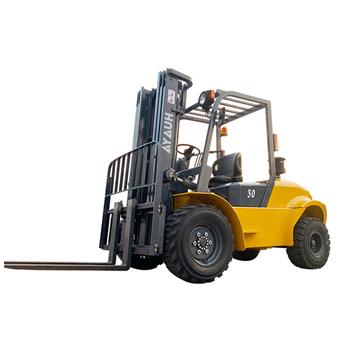
If a standard forklift is a “passenger car,” then an off-road forklift is a rugged “SUV.” Designed specifically to tackle challenging outdoor environments, it handles everything from muddy construction sites to rocky wilderness terrain with ease. Here’s why it’s a “game-changer” for outdoor operations:
These forklifts feature a sturdy and durable design, with a reinforced frame and increased ground clearance. This allows them to easily navigate uneven, rugged, and bumpy terrain.
Off-road forklifts are equipped with pneumatic or solid foam tires, which provide excellent traction on soft surfaces such as dirt, gravel, or sand. The tires’ large size and sturdy construction further enhance ride comfort.
Most off-road forklifts are equipped with diesel engines, providing ample power to handle heavy loads and transport them over long distances. In addition, they are capable of operating in extremely harsh weather conditions.
When operating on rough terrain, safety is the top priority. Off-road forklifts are typically equipped with stabilizing outriggers or all-wheel-drive systems to ensure safe and stable operation.
Let's compare the two side by side for a quick overview:
| hallmark | Standard Forklift | Rough Terrain Forklift |
| Terrain | Smooth, flat road surface | Rugged terrain |
| tires | Solid Tires | Pneumatic tires or foam-filled tires |
| Power Source | Electricity or Gas | diesel fuel |
| ground clearance | 低 | 高 |
| typical use | Indoor Material Handling | Outdoor Construction, Agriculture |
Your choice depends entirely on the specific requirements of the job at hand. If your work primarily involves indoor operations, narrow aisles, and controlled environments, a standard forklift is your best option. Conversely, if you need to handle harsh outdoor weather, rugged terrain, and heavy loads, an off-road forklift will be your most reliable partner.
Understanding the differences between these two types of forklifts is crucial for ensuring efficiency and safety during operations. Choosing the right equipment not only saves you time and effort but also effectively reduces equipment wear and tear. Whether you’re moving pallets in a warehouse or maneuvering through a muddy construction site, there’s a forklift that perfectly meets all your needs.